Real fire tests · Lithium-ion

Real fire tests on lithium-ion batteries

We drive real cells and packs into thermal runaway, apply the agent and measure what happens next. We have run more than 70 of these tests for customers with different cells, among them NCM and LFP. The test data and the test method are for sale as one package, directly from SafeWav.

real fire tests run for customers
70+
cell chemistries tested
NCM · LFP · LCO
ways the agent is applied
Fixed system · Portable
sold as one package
Data + method

Test method

One method, from the first cell to the report

Every test follows the same six steps. What changes is the cell, the size of the sample and the way the fire is started.

  1. 01

    Define the test

    Cell chemistry, sample size and the question to answer. The acceptance criteria are written down before the test.

  2. 02

    Prepare the sample

    The cells are fully charged 48 hours before the test and each voltage is checked. Thermocouples are fixed across the pack.

  3. 03

    Start thermal runaway

    Overcharge, a heating plate, or both. The trigger is switched off when thermal runaway develops.

  4. 04

    Apply the agent

    A fixed water-mist system or a portable extinguisher, released when the first cell goes into thermal runaway. Pressure, time and agent quantity are recorded.

  5. 05

    Observe

    The pack stays under observation for 20 minutes to 1 hour. Re-ignition, peak temperatures and the voltages of the remaining cells are recorded.

  6. 06

    Report

    Temperature curves, video, voltages and agent consumption, together with set-up, procedure and result, in one report.

What is set for each test

We fix these points with the customer before a test. The examples come from tests we have run.

Cell chemistry
NCM, LFP, LCO. Pouch cells and prismatic cells.
Sample
Modules and packs. Examples: 3P4S LFP pack, 710.4 Wh LCO pack, 1128.5 Wh NCM module.
Trigger
Overcharge (electrical abuse), a heating device between cells (5–10 °C/min), or both together.
Agent application
Fixed water-mist system (4 MPa for 240 s) or portable extinguisher (6 L), released when the first cell goes into thermal runaway.
Measurement
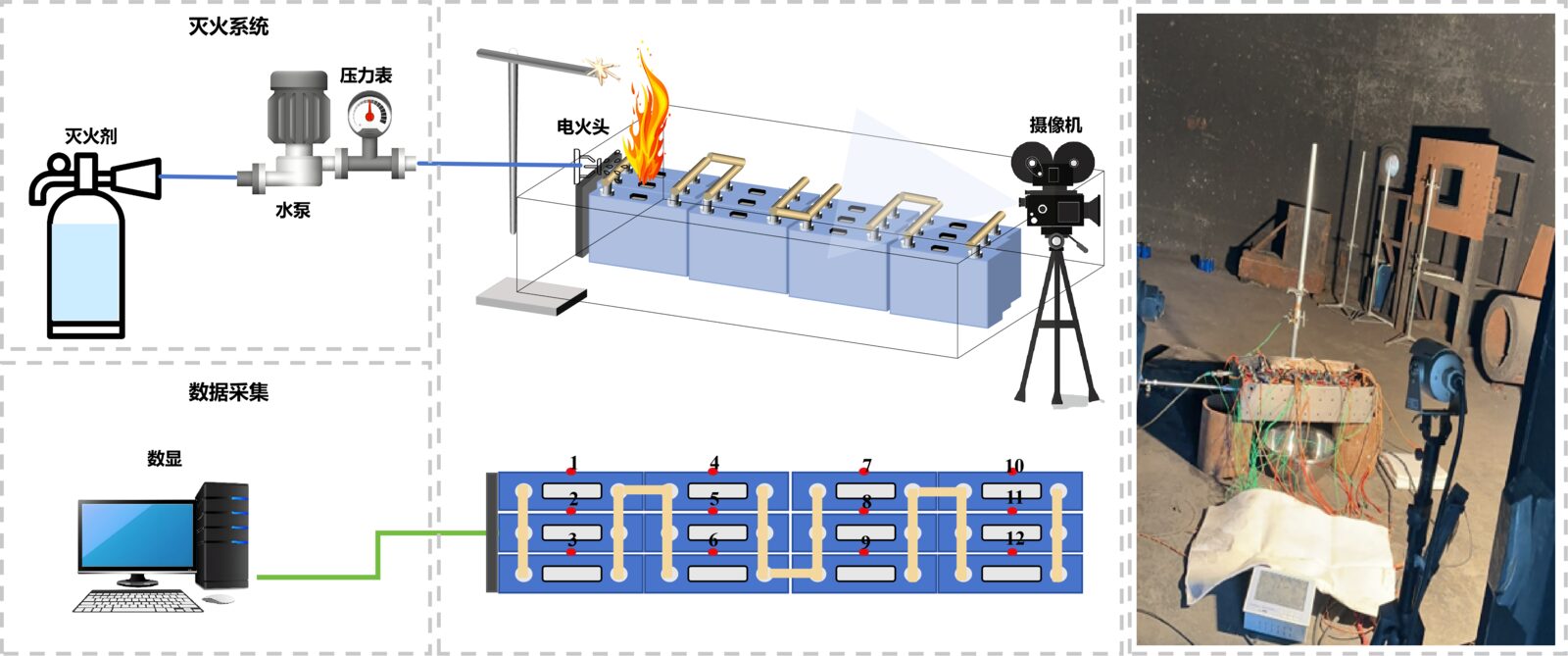
Thermocouples across the pack (12 channels in the fixed-system test), video of the whole run, cell voltages after the observation time, agent consumption.
Comparison
The same procedure repeated with deionized water and with another agent, so that the curves can be compared.
Acceptance criteria
Written before the test. Examples: flame out, no re-ignition within 20 minutes or 1 hour, at least one cell group still at 3.7 V or more, agent consumption within the limit.
Reference procedures
KFI criteria No. 630 for small lithium-ion battery fires, NTA 8133+A1, and the Chinese technical requirements for fire control devices of electric-bus battery boxes.

These are in-house tests. A result applies to the cells and conditions of that test. It is not a third-party certification.

Example record · LFP pack · Fixed system

Same pack, same procedure, three agents.

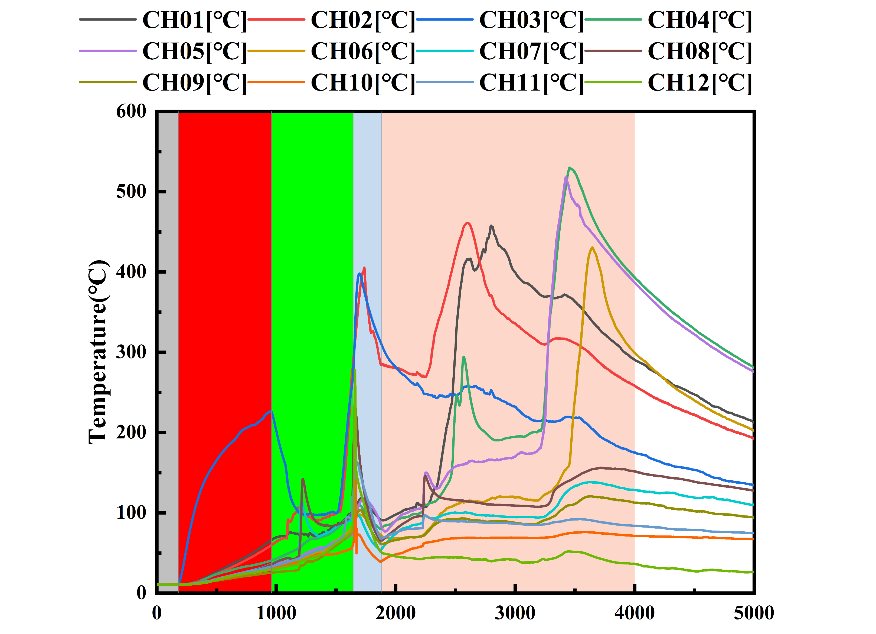
A fully charged lithium iron phosphate pack is overcharged and heated into thermal runaway, then sprayed by a water-mist system. Thermocouples across the pack record what happens next.

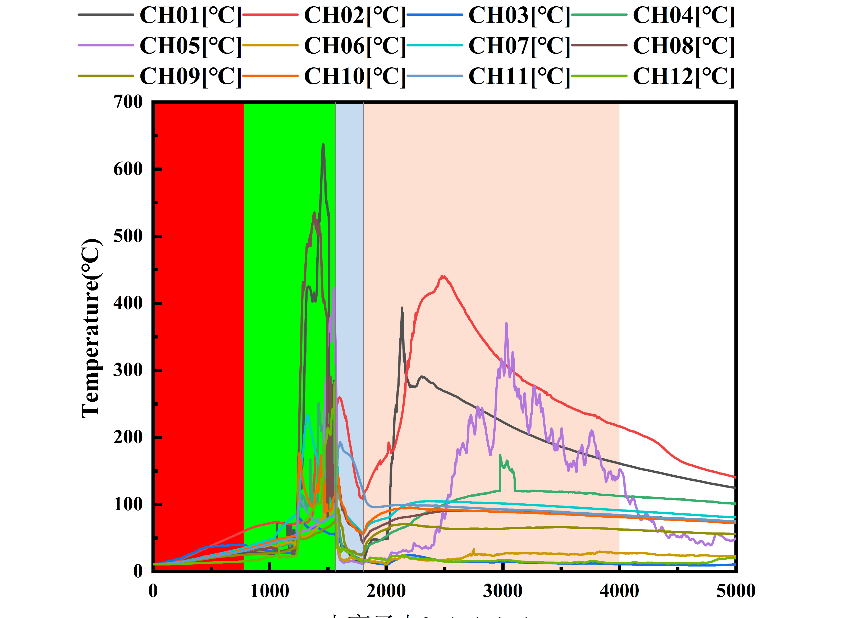
Deionized water> 400 °C
0100200300400500600700010002000300040005000Time (s)Temperature (°C)439 °C
Flame out
2 min
Re-ignition
Yes
Max. after extinguishing
> 400 °C
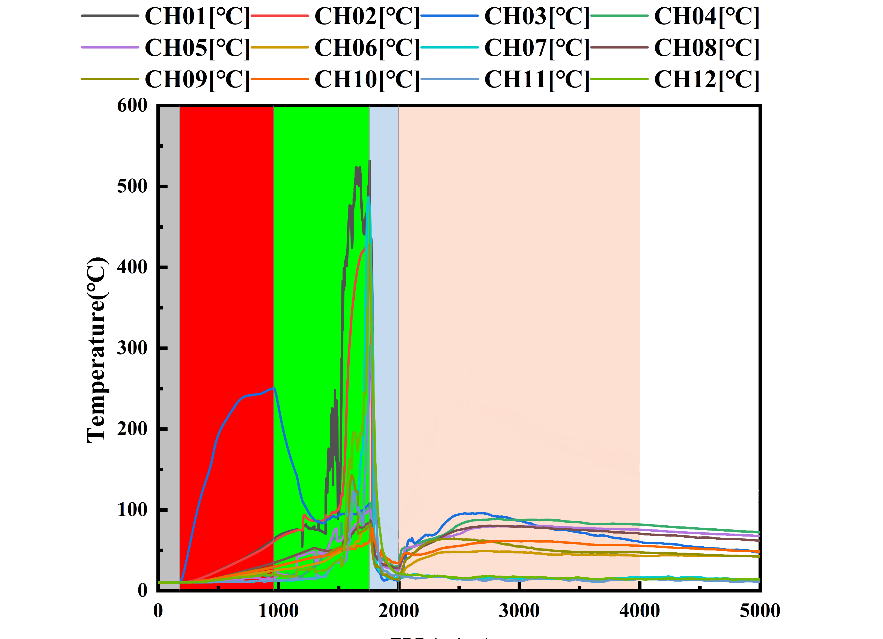
A mainstream Li-ion extinguishing agent> 500 °C
0100200300400500600010002000300040005000Time (s)Temperature (°C)529 °C
Flame out
1 min 20 s
Re-ignition
Yes
Max. after extinguishing
> 500 °C
FW-18< 100 °C
0100200300400500600010002000300040005000Time (s)Temperature (°C)96 °C
Flame out
2 s
Re-ignition
No
Max. after extinguishing
< 100 °C

Test phases (background bands)

  • Heating / Overcharging · Fully charged pack held in overcharge (180 s), heating plate on (780 s)
  • Runaway · Heating and overcharge off; runaway develops
  • Spray · Water-mist system, 4 MPa, 240 s
  • After Extinguishing · Pack left under observation

Thermocouple channels

  • CH01
  • CH02
  • CH03
  • CH04
  • CH05
  • CH06
  • CH07
  • CH08
  • CH09
  • CH10
  • CH11
  • CH12

The three runs on video

Deionized water2 min · Re-ignition: Yes
A mainstream Li-ion extinguishing agent1 min 20 s · Re-ignition: Yes
FW-182 s · Re-ignition: No

What the test showed

  • Cooling effect: FW-18 > a mainstream Li-ion extinguishing agent > deionized water.
  • FW-18 terminated thermal runaway; with the other two agents the pack re-ignited.

In-house comparison test. Curves are digitized from the published test charts and are approximate. Videos have no audio track; where marked in the source, playback is at double speed.

Test package

Buy the test data and the test method

The data and the method are a paid package. You buy it directly from SafeWav and use it to plan, run or review your own battery fire tests.

What the package contains

  • Test data. Temperature curves, videos, voltages and results of tests on NCM, LFP and other cells.

  • Test method. The procedure as a document: sample preparation, trigger settings, sensor positions, release timing, acceptance criteria and safety measures.

  • A test on your cells. We run the test with your cells or packs and deliver the data and the report.

How to buy

  1. 1

    Inquiry

    Tell us your cells and what you want to find out.

  2. 2

    Scope and quotation

    We agree what the package contains and send a quotation.

  3. 3

    Delivery

    You receive the data and the method documents. For a test on your cells, we agree a test date.

Ask for the test package

Tell us what you need. We answer by email with scope and quotation.

Cell chemistry · optional

TEST RECORDS

Set-up, procedure and result of each test

Four tests: a fixed water-mist system on an LFP pack, portable extinguishers on LCO and NCM packs, and Class A wood cribs.

01Fixed fire extinguishing system test: LFP pack

In-house comparison test, three agents under the same procedure. Method reference: General technical requirements for fire prevention and control devices for lithium-ion power battery boxes of electric buses.

Set-up
CellsCATL lithium iron phosphate (LiFePO₄ / graphite), 173 × 46 × 133 mm
Test pack3P4S: three cells in parallel per module, four modules in series
PreconditioningFully charged 48 h before the test; 3.6–3.65 V per cell verified
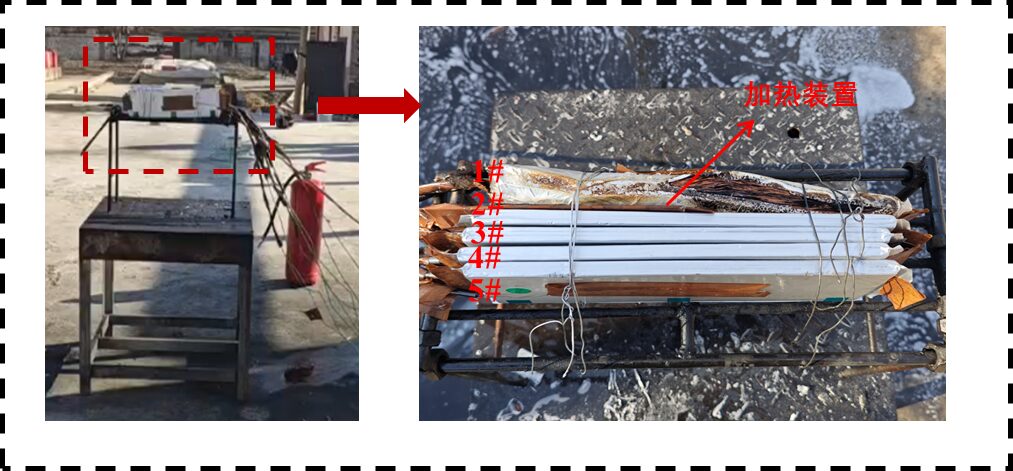
Instrumentation12 thermocouple channels (CH01–CH12)
SuppressionWater-mist system, constant 4 MPa, 240 s spray

Procedure

  1. Keep the fully charged battery in an overcharged state.
  2. After 180 s, heat the battery with a heating plate for 780 s, then stop heating and overcharging and let thermal runaway develop.
  3. Activate the water-mist system: constant 4 MPa for 240 s.
  4. Observe the pack after extinguishing.

Acceptance criteria

  1. The flame is completely extinguished and there is no re-ignition within 1 hour.
  2. After 1 hour, at least one unburned battery cell remains.

Result

AgentFlame outRe-ignitionMax. after extinguishing
Deionized water2 minYes> 400 °C
A mainstream Li-ion extinguishing agent1 min 20 sYes> 500 °C
FW-182 sNo< 100 °C
  • Cooling effect: FW-18 > a mainstream Li-ion extinguishing agent > deionized water.
  • FW-18 terminated thermal runaway; with the other two agents the pack re-ignited.
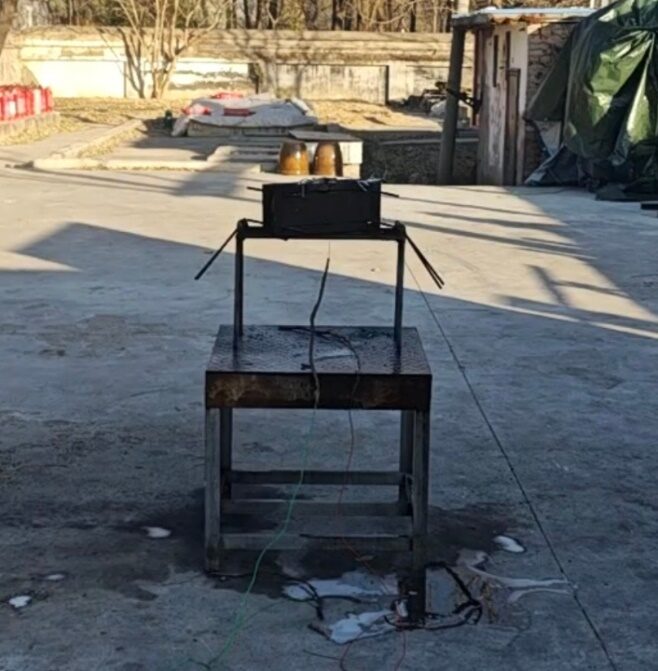
LFP fixed-system test: rig schematic, thermocouple layout and photo
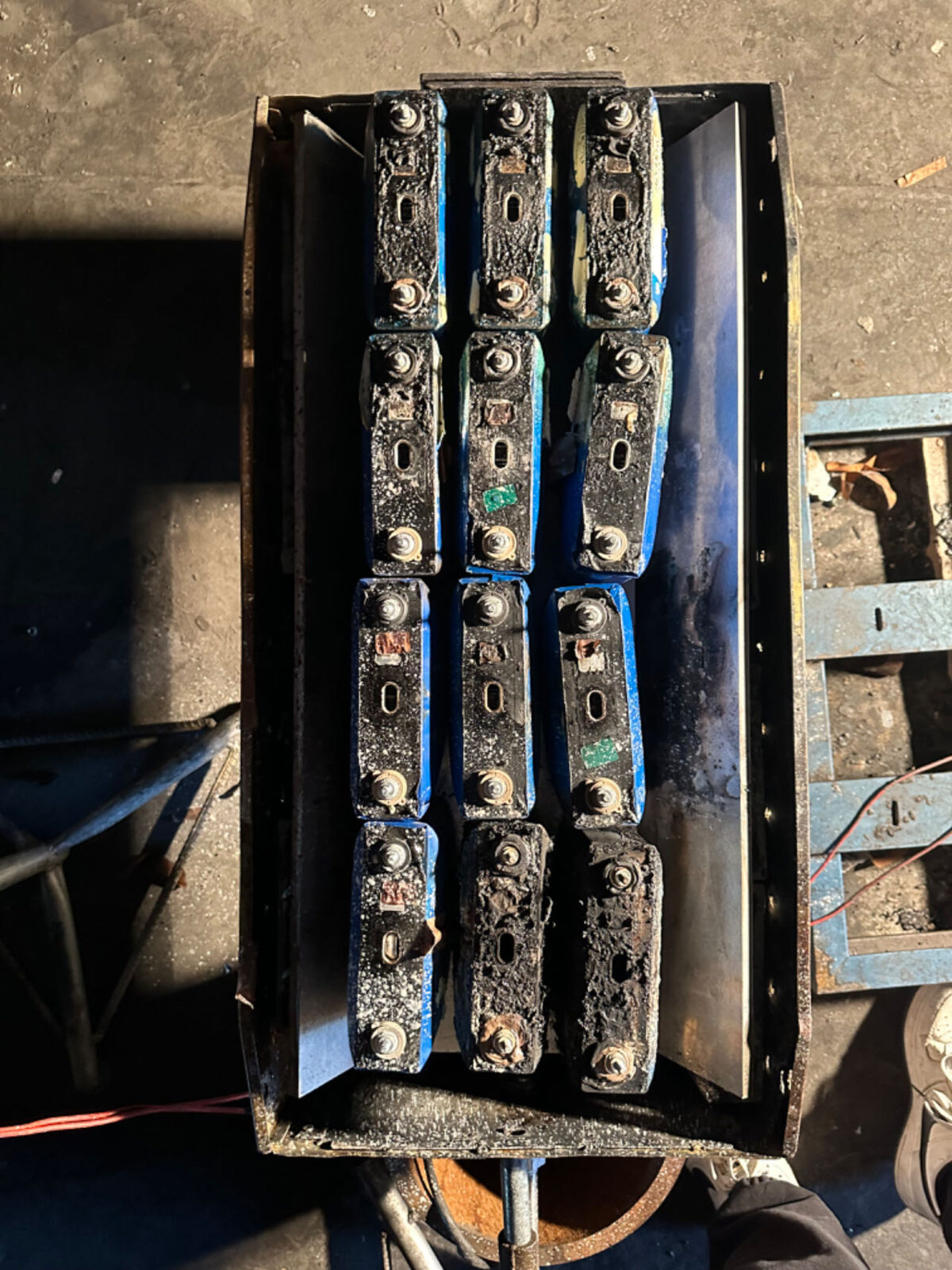
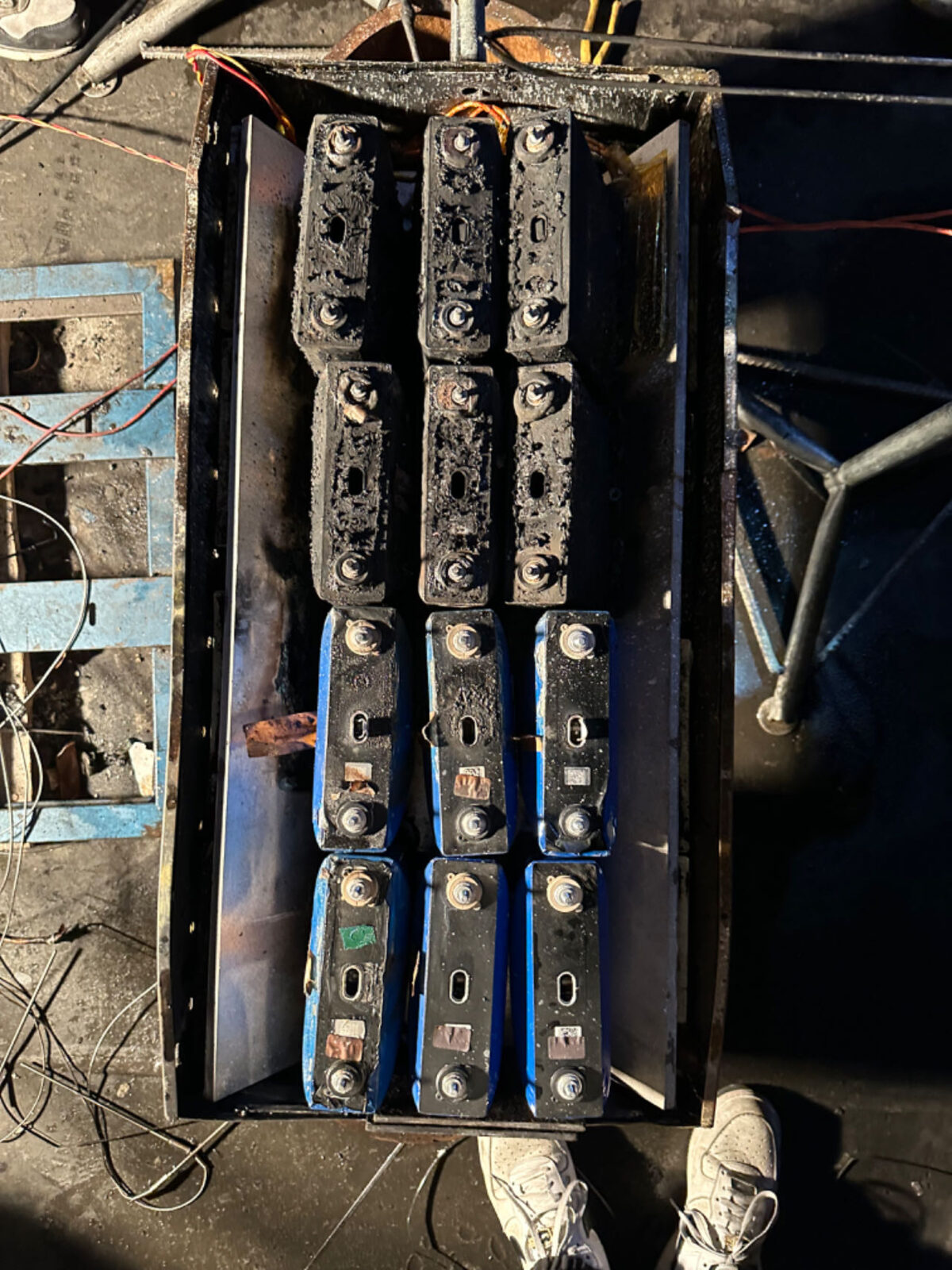
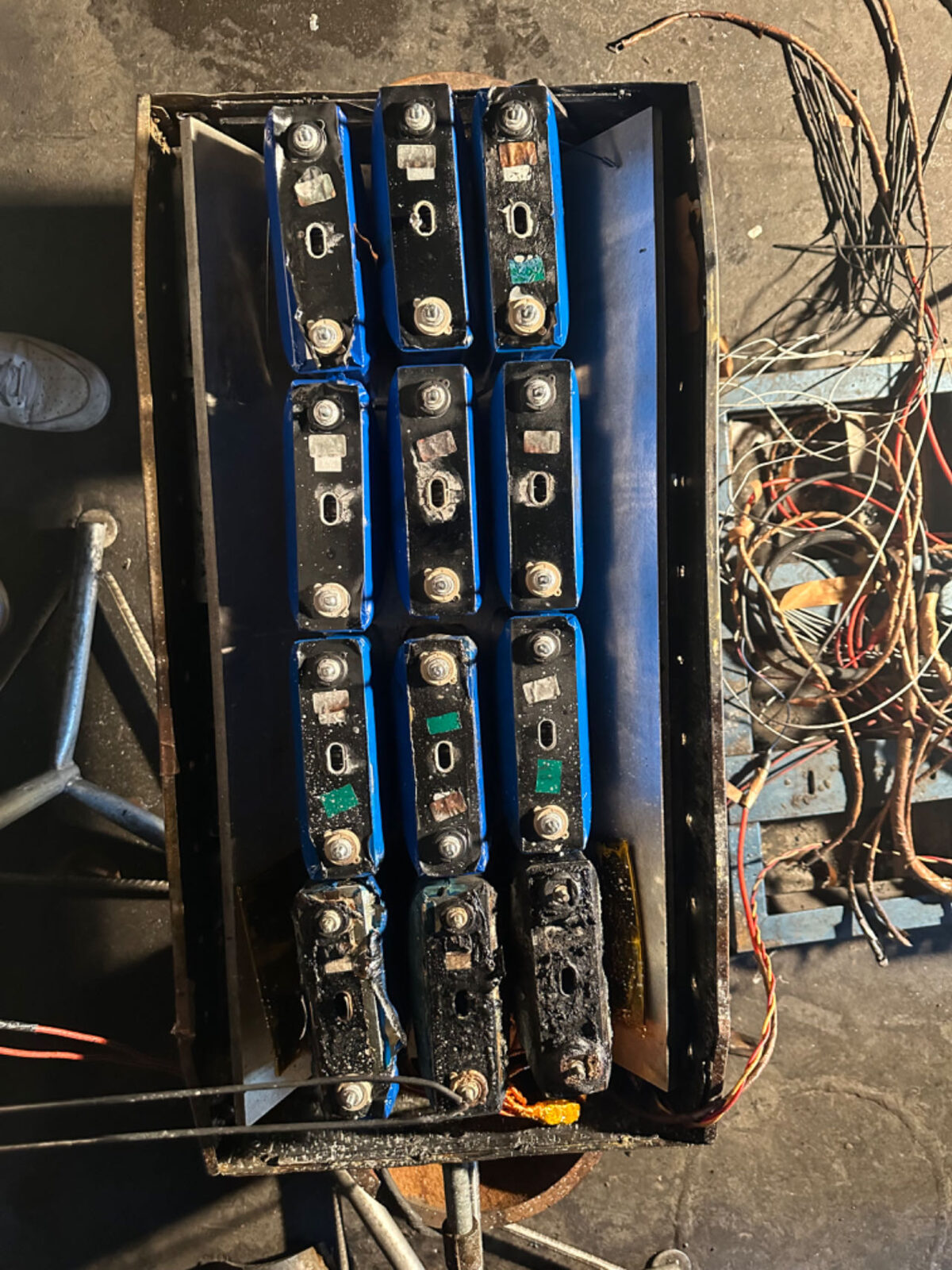
Pack after the test: Deionized water
Pack after the test: A mainstream Li-ion extinguishing agent
Pack after the test: FW-18

02Portable extinguisher test: LCO pack

In-house test. Method reference: KFI certification criteria for the extinguishing performance of extinguishers on small lithium-ion battery fires, No. 630, 2024-12-18.

Set-up
CellsNew LiPo pouch cells, LCO (LiCoO₂), 8000 mAh, 3.7 V
Test pack6 groups of 4 cells in series (14.8 V per group), 710.4 Wh
PreconditioningFully charged 48 h before the test; ≥ 4.1 V verified; enclosures removed
Extinguisher6 L, FW-18

Procedure

  1. Overcharge group #3 to induce thermal runaway by electrical abuse.
  2. When the first battery enters thermal runaway, discharge the extinguisher.
  3. Observe for 20 minutes, then measure the battery voltages.

Acceptance criteria

  1. All flames are extinguished and all batteries remain inside the test apparatus.
  2. No re-ignition during the 20-minute observation; at least one group of 4 cells in series has not caught fire and holds a cell voltage of ≥ 3.7 V.
  3. Agent consumption ≤ 9 L for a 600 Wh battery module.

Result

One 6 L FW-18 extinguisher put out the 710.4 Wh pack fire; three groups kept their voltage.

Flame extinguishedYes
Thermal runaway again within 20 minNo
Groups with qualified voltage3 of 6
Group voltages #1–#6 (V)16.36 / 0 / 0 / 0 / 16.65 / 16.83
Meets acceptance criteriaYes
LCO 710.4 Wh pack: extinguishing with a 6 L FW-18 extinguisher
LCO 710.4 Wh pack after the 6 L FW-18 test: voltage measurement
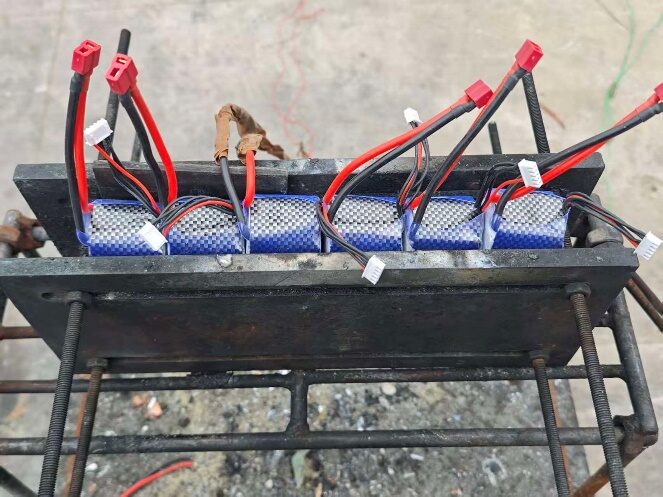
LCO test module: 6 groups of 4-series pouch cells, 710.4 Wh
LCO test stand
LCO test stand

03Portable extinguisher test: NCM pack

In-house test. Method reference: NTA 8133+A1.

Set-up
CellsLG E61 NCM pouch cells, 11.5 × 98 × 350 mm
Test pack5 cells, 1128.5 Wh
PreconditioningFully charged 48 h before the test; ≥ 4.05 V verified
Extinguisher6 L, FW-18, pre-heated to 40 °C

Procedure

  1. Pre-heat the whole extinguisher to 40 °C.
  2. Place a 300 W heating device between cells #1 and #2 and raise the temperature at 5–10 °C/min.
  3. When the first cell goes into thermal runaway, discharge the extinguisher immediately.
  4. Observe for 1 hour, then measure the cell voltages.

Acceptance criteria

  1. The flame is completely extinguished and there is no re-ignition within 1 hour.
  2. After 1 hour, at least one unburned cell remains, with a voltage above 3.7 V.
  3. Agent consumption ≤ 9 L for a 1000 Wh battery module.

Result

One 6 L FW-18 extinguisher put out the 1128.5 Wh pack fire; four of five cells kept their voltage.

Flame extinguishedYes
Thermal runaway againNo
Cells with qualified voltage4 of 5
Cell voltages #1–#5 (V)thermal runaway / 4.06 / 4.09 / 4.07 / 4.10
Meets acceptance criteriaYes
NCM 1128.5 Wh pack: extinguishing with a 6 L FW-18 extinguisher (full run)
NCM 1128.5 Wh pack after the 6 L FW-18 test: voltage measurement
NCM test set-up: 5 pouch cells with the heating device between #1 and #2

04Class A fire test: wood cribs

In-house test. Method reference: GB 4351 portable fire extinguishers.

Set-up
Wood cribOn a support of two angle irons, top (400 ± 10) mm above ground; sticks of (39 ± 1) mm square cross-section
Extinguishers950 mL, 3 L and 30 L, FW-18

Procedure

  1. Place the ignition pan under the crib and add water to a depth of 30 mm.
  2. Weigh the crib; the target mass is (55 ± 2)% of the initial mass.
  3. Pour fuel into the pan and ignite it.
  4. When the crib has burned down to the target mass, discharge the extinguisher continuously at full opening: first from 1.8 m in front of the crib, then closer, onto the top, bottom, front and sides, not the back.
  5. Observe for 10 minutes.

Acceptance criteria

  1. The fire is completely extinguished and there is no visible flame within 10 minutes after the extinguisher is fully discharged.
  2. If the crib collapses during the test, the test is invalid and is repeated.
ClassSticksStick length (mm)ArrangementIgnition pan (mm)Ignition fuel
0.5A454009 layers × 5 sticks300 × 300 × 1000.63
2A11263516 layers × 7 sticks535 × 535 × 1002.0
6A23092523 layers × 10 sticks825 × 825 × 1004.8

Result

All three sizes put out their crib with no re-ignition within 10 minutes.

ExtinguisherFlame extinguishedRe-ignition within 10 minRatingMeets criteria
950 mL FW-18YesNo0.5AYes
3 L FW-18YesNo2AYes
30 L FW-18YesNo6AYes
Class A wood-crib fire, 950 mL FW-18: 0.5A
Class A wood-crib fire, 3 L FW-18: 2A
Class A wood-crib fire, 30 L FW-18: 6A

Conventional extinguishing agents on lithium-ion battery fires

Agent typeCommon agentsMechanismEffect on Li-ion battery fires
GaseousHalon 1301, Halon 1211Chemical inhibitionFast, but the fire easily rekindles
GaseousCO₂, IG-541, IG-100SmotheringLimited effect, poor cooling, prone to re-ignition
GaseousHFC-227ea, 2-BTPCooling, smothering, chemical inhibitionPoor in large spaces, limited cooling, prone to re-ignition
Dry powderABC dry powderIsolation, cooling, smothering, chemical inhibitionAlmost no effect, prone to re-ignition
AerosolK-type, S-typeSmothering, chemical inhibitionFast, but prone to re-ignition
LiquidWater, AF-31, A-B-DCoolingUnremarkable cooling, high water consumption, conductive, risk of re-ignition
LiquidFoamCooling, separationUnremarkable cooling, conductive, risk of re-ignition
LiquidOrdinary water-based agentCoolingGood cooling; conductive, no explosion suppression
LiquidFW-18Cooling and chemical inhibitionRapid fire suppression, efficient cooling, explosion suppression, termination of thermal runaway, insulating and non-conductive

Reports and intellectual property

Type test report
1
Commissioned test reports
3
1500 V voltage breakdown test report
1
Technical appraisal certificate for a lithium-ion battery dedicated extinguishing agent (China)
Obtained
Patent applications
32
Authorized invention patents
4
Authorized utility model patents
3
Registered software copyrights
6
Academic papers
26

Notes on this data

  • The tests on this page are in-house tests carried out with the methods named for each test. They are not certifications.
  • Curves are digitized from the published chart images of the FW-18 technical presentation (2026-01-27). Approximate: about +/-9 s and +/-1.5 °C on the thermal-runaway charts; where lines overlap, the hidden line is taken to follow the line covering it. Not the raw logger data.
  • “A mainstream Li-ion extinguishing agent” is a commercially available agent tested under the same procedure; it is not named.

FW-18 Base Data Sheet · v1.0 · 2026-11-26

Free sample

Base materials for your own evaluation

Take the data sheet, the curve tables and the test videos into your own review or use them to plan a comparison test.

FW-18 test data kit

Everything below except the videos, in one archive: data sheet, key figures, curve tables, source charts, set-up photos.

SafeWav-FW-18-Test-Data-Kit-v1.0.zip · 2.1 MB · v1.0 · 2026-11-26

Download the kit

Data sheet

Curve tables (CSV)

Digitized from the published charts; approximate.

Charts as published

These files are a free sample. The complete test data and the test method are in the paid test package above.

The agent in the tests

FW-18 technical data

What the agent is and how it compares with deionized water.

Key technical specifications compared with deionized water

PropertyDeionized waterFW-18
Cooling capacity (%)100%330%
Electrical conductivity (μS/cm)2.28 μS/cm6.7 μS/cm
PFAS & PFOS contentNone0% PFAS
Freezing point (°C)0 °C−40 °C
Explosion overpressure vs. air explosion (%)+11.8%−30.8%
Voltage withstand—No breakdown at 1500 V
Cooling capacity. Cumulative heat exposure reduction relative to deionized water (= 100%).
0100200300400500600040008000120001600020000Time (ms)Explosion overpressure (kPa)Deionized waterAirFW-18
Explosion overpressure vs. air explosion. Change in peak explosion overpressure compared with the explosion in air. FW-18 −30.8%; deionized water +11.8%.
−60−40−2002040050100150200250Time (s)Temperature (°C)≈ −41 °C
Freezing point. The measured cooling curve shows the freezing plateau at about −41 °C.

How the agent works

Microemulsion: a thermodynamically stable system formed by the micellar reaction of an oil phase, a water phase, a surfactant and a co-surfactant.

  • Dispersed oil phase of 1–100 nm, uniform in size and spherical.
  • Low electrical conductivity.
  • Can decompose and absorb combustible gases such as H₂ and CO.
  • Chemical inhibition interrupts the combustion chain reaction; physical cooling removes heat from the cell surface.

Five core functions

  1. 01Rapid fire suppression
  2. 02High-efficiency cooling
  3. 03Effective explosion suppression
  4. 04Termination of thermal runaway
  5. 05Insulating and non-conductive

Applies to

Cell chemistries
LCO (lithium cobalt oxide), NCM (lithium nickel cobalt manganese oxide), LFP (lithium iron phosphate)
Equipment
Portable extinguishers, Fixed fire protection systems
Fires
Lithium-ion battery fires, Class A
Ambient temperature
−40 °C to 60 °C